Kurt Vonnegut
November 11, 1922- April 11, 2007
I tell you, we are here on Earth to fart around, and don't let anybody tell you different.
Thursday, April 12, 2007

Sunday, April 8, 2007
La Science des Rêves
 La Science des rêves, or the Science of Sleep, was a fantastic blend of whimsy and depression. It is very reminiscent of a Charlie Kaufman script (Being John Malkovitch, Eternal Sunshine of the Spotless Mind), in that there is a fine line between what's real and what's not that is being continuously crossed. This should come as no surprise coming from writer/director Michele Gondry, who co-wrote and directed Eternal Sunshine. I say this a lot, but this movie cements him as a powerful force in film-making. He manages somehow to blend the charming and the heartbreaking.
The movie centers on Stéphane Miroux (Gael Garcia Bernal), as he moves in with his mother and starts a dead-end job at a calender design company. The movie flips back and forth between his daily life, and his dreams. Much of the movie is even narrated by himself- in his own head set up to resemble a television studio. His dreams are generally marked as clearly fantasy, but sometimes he gets them mixed up. This bleeds over into his waking life as he does things he is unaware of while sleeping, and frequently thinks he is sleeping when he is indeed awake.
Miroux is fascinating character. He is obviously very creative, but also has a hard time keeping his sense of reality. This makes it very difficult for him to relate to other people- resulting in conflicts with his co-workers, and a bizarre non-existent relationship with his neighbor, Stephanie (Charlotte Gainsbourg). This is the truly sad part of the movie. They are clearly interested in each other, but Miroux throws it away at every turn, realizing his love only when he is asleep.
The movie is almost plays out as a tragic study of our own inhibitions. It plays our consciousness, and our desires as two conflicting forces. They fight each other at great pain to ourselves. Miroux is this conflict personified, and even explained through his narrated thoughts. Some amusing realizations are reached when he sleepwalks, and when he influences his dreams (listening to recordings, falling asleep with his feet in a fridge, etc). The dream sequences themselves are where Gondry really shines. They feature some fantastic stop motion animation as Miroux lives out his dreams.
The movie was obviously a little difficult to follow, accented by the characters switching between French, Italian, Spanish, and English. The pacing was also a little off. It started out a little slow, and took a while to build up momentum into a truly interesting story (instead of just an experimental curiosity). It also lost some momentum towards the end. I was not disappointed with how it ended, it just fizzled a little bit arriving at that conclusion. This is being really nit-picky, since I did not find much else wrong with it.
The Science of Sleep is an interesting movie on several levels. The story is genuinely powerful, and you feel for each of the characters, almost crying along with them. The fairly simple story is enhanced by the visuals. It was the animation that initially drew me to the movie, but in the end, it was the story that truly captivated me.
5/5
Premonition
 This film is a little difficult to review without giving too much of it away. Surprise is the only thing this movie has going for it, and there aren't even many of those. Premonition is dull, and for a potentially twisted thriller- kind of obvious. Both the acting and the cinematography were mediocre at best.
The movie follows Linda Hanson (Sandra Bullock) as she learns her husband was killed in a car accident. The catch is, that she waked up the next day and finds that he's still alive. She keeps bouncing back and forth between these different states of mind and time, trying to figure what is real and what isn't. The interesting route this movie takes presents the story non-linearly not only to the audience (which has been done a thousand and one times before), but to the main character as well. She is just as confused as we are. Unfortunately, the audience figures it out long before she does- about half way through the movie to be exact. After this point, the movie doesn't offer much surprise.
The plot itself features numerous glaring plot-holes. Normally I can overlook inconsistencies, but these are so integral to the plot, that they genuinely ruined the movie for me. I won't go into any of them here, because I don't want to spoil anything. Suffice it to say that the entire premise of the movie renders some scenes meaningless, and conflicting. The climax is fairly obvious. Director Mennan Yalo tries to direct the audience's attention away from the clearly obvious conclusion. He doesn't succeed.
The acting troubled me. It seemed almost as if Bullock was acting to herself, and not actually interacting with anyone else. Potentially powerful scenes between her and her husband (Julian McMahon just fall flat. In fact, the best roles in the movie were their two daughters, played by Shyann McLure, and Courtney Taylor Burness. They were both darling, and the most emotional of any of them. McMahon especially seemed limp the entire movie. Maybe this is a little harsh, but I really expect more from Sandra Bullock.
The plot was not the only inconsistent aspect of the movie. I think they genuinely tried to incorporate lighting into the plot elements. I didn't quite follow how they all correlated, but I think upon a second viewing it may be more evident. I think this is a powerful atmospheric tool if done well. Unfortunately, even within scenes, the lighting was sporadic. Color schemes seemed to change between shots within the same scene- drastically. So much so that it actually took me out of the movie. It amazed me how these errors made it through to the final cut.
The plot was interesting, and I feel it had potential. There's certainly a deeper meaning in it, that I feel they did get across. The movie on whole, however, fell well short of its potential. The acting and cinematography were spotty, and the plot itself was filled with holes. Perhaps this could have all been overlooked in an entertaining psychological thriller. Unfortunately, however, Premonition was just dull.
2/5
Saturday, April 7, 2007
Grindhouse

grind house –noun Slang.
| 1. | a burlesque house, esp. one providing continuous entertainment at reduced prices. |
| 2. | a movie theater that shows films throughout the day and all or most of the night. |
Both of those definitions sum up Quentin Tarantino's and Robert Rodriguez's double feature very well. Grind Houses were theaters that were big back in the seventies playing low budget B movies, blaxsploitation, and horror movies. They were named after the studios that would grind out these films, releasing dozens a year (many from the same directors over and over again). Rodriguez and Tarantino capture this spirit wonderfully, and each one uniquely visits his inspiration. Both films feature jarring cuts and scratchy film (all features of those low budget movie house days). Each of them even features a missing reel. I honestly hope those were actually filmed, and may be featured as a bonus feature upon release on DVD. Though experiencing this on DVD would almost ruin the atmosphere of watching it in a movie house. They go about it in entirely different ways, but each does a fine job of reminiscing about those days.
Before I get into each of the movies, I need to discuss my favorite (and judging from the reaction in the sold out show- the audience favorite as well). Between the two movies they had fake movie trailers for upcoming horror movies directed by prominent directors. Rodriguez provided one of the trailers for a movie he actually wrote and planned on shooting. Rob Zombie, Eli Roth, ad Edgar Wright (Director of Shaun of the Dead) provide three other hilarious trailers.
Planet Terror
Robert Rodriguez's zombie flick started off the night. This movie is nonstop action, with sprinklings of scares, and heavy dose of hilarity. He pays homage to the movies of George Romero's Dead series, and the Italian zombie movies of the day. Planet Terror is overblown, ridiculous, and rivals Peter Jackson's Dead Alive for the bloodiest movie I have ever seen. I get the impression that he wants the audience to have as much fun watching the movie as it probably was to write it.
The cast is actually delightful. Rose McGowan plays the lead heroin- Cherry Darling. She loses her leg early on in a zombie attack, and eventually gets a machine gun to replace it. This is just an example of the absurd and downright silly nature of the movie. Freddy Rodriguez plays Wray, the hero, and in a hilarious twist, the missing reel happens to contain the segment where we find out who he is. The cast for Planet Terror is rounded out with Mary Shelton, Michael Beihn, and Bruce Willis. They all do a fantastic job, and look like they're just having fun.
There were a few spots that were just a little too bizarre for me. Most of these included testicles, and one featured an appearance by Tarantino- who I think has to be in every movie he's involved with even though he'd not that great of an actor. There were spots like these where Rodriguez seemed to let the gross-out nature of the movie get away from him, and it almost seemed like the zombies were writing it themselves. These spots were only a few, and went by fairly quickly.
The plot (if that's what you can call it) revolves around a gas that was produced for the military. It gets released on a small town, and creates zombies. There's nothing original about this movie. But it's how he accomplishes it that makes this movie so good. While poking fun at the genre, he shows an undying love for it. It's comparable to Wes Craven's turn in Scream. Rodriguez is one of the best filmmakers of current. He directs, DPs, edits, writes, and even does the music for most of his movies. He has to be one of the most versatile directors out there, not only doing this, but Sin City, El Mariachi and sequels, even the Spy Kids series. He does it all, and he does it all very well.
Death Proof
This was Quentin Tarantino's contribution to Grindhouse. This one slowed down the continuous action of Planet Terror considerably. It's a fine film, but takes such a different approach. This one features Kurt Russel who stalks and kills women with his car. If Planet Terror paid tribute to the obnoxiously overblown action movies of the day, Death Proof plays homage to the gritty, and dirty movies of the seventies. He blatantly shows his inspirations, even featuring a conversation about the genius of Vanishing Point. This movie may not have been as fun as Rodriguez's, but it was still quite good in its own right.
I feel that Zoe Bell (playing herself) was without a doubt the star of this movie. This is despite standout performances by Rosario Dawson and and Tracie Thoms (who could be described as the female Samuel L. Jackson. Bell, a veteran stunt person, plays a fantastic role on the hood of a car in one of the most exciting chase scenes I have seen in a long time. Uma Therman (Tarantino's muse) was absent from Death Proof, but Bell had played her stunt double in Kill Bill, so in a way, she was still there. I was happy to see the stunt person getting the spotlight this time.
Death Proof is clearly Tarantino. Unlike Rodriguez, who does not have any specific style to his movies, every Tarantino film is obviously one of his. This is no exception. It is very dialog heavy, most of it random and meandering- but always very witty. The dialog is saturated with carefully placed profanity that seems to be a trademark of his scripts. Despite the seemingly shallowness of the characters, you really start to feel for them. Rarely have I been to a movie where the audience is cheering at the end.
The problem with Death Proof is that Tarantino could not quite get himself out of his own style and immerse the film in that 70's action gear head flick. He tried to add too many layers to the dialog, and didn't let the cars do the speaking quite enough. I really liked the movie, but I didn't think it quite got what they were looking for with the Grindhouse idea. Rodriguez, on the other hand, completely let the genre do the thinking, and let that shape the movie. Tarantino was still a little too deliberate in the script. I can't really fault him for this, though, because he did craft a really good script.
On a whole, the movies were fantastic. Each one had a few flaws, but they were supposed to be bad movies in the first place. I don't think either director was able to completely get out of their own skin and produce a truly deliciously B movie (I think Rodriguez came the closest out of the two to accomplishing the Grind house spirit). I wonder how different of an experience it would have been to have Death Proof first, and Planet Terror second. Planet Terror was a thrill ride, and Death Proof just seemed to lose momentum. However, Planet Terror did not have the crowd pleasing ending, so I guess it could have gone either way. One thing is certain, these two movies have to be seen together, and they have to be seen in the theater. They were made for fans of movies, and specifically fans of horror movies. If you go in with the excited mentality of just having a good time, trust me, you will.
5/5
Monday, April 2, 2007
Flushed Away
 This movie cements my opinion that Oscar blew it this year in the animation category. Flushed Away is a close second place behind Over the Hedge (another Dreamworks picture), and neither was even nominated. This is Aardman Entertainment's first fully CG film. You may recognize some of their past stop-motion animation with Wallace and Gromit, and Chicken Run. They make the transition into CG animation flawlessly. Flushed Away has a good story, strong characters, and brilliant animation.
The plot follows Roddy, a domesticated mouse (played by Hugh Jackman), who through a series of mishaps, gets flushed down the toilet. He finds himself lost in the sewer, and stumbles upon an entire city of sewer rats- a sort of Venice under the street. He meets up with Rita (played by Kate Winslet), and their chemistry is vibrant. They truly go back and forth between falling for each other, and hating each other. They must tolerate each other, however, to stop the villain of the movie- the Toad (played by Ian McKellen). Andy Serkis (yeah, he does more than Gollum and King Kong) and Jean Reno also provide fantastic voices to complete the main cast.
Of course, the primary aspect to talk about is the animation. The reason they decided to go CG was because of the amount of water and its important role in the film. It would have been too difficult to do fluid effects for every shot of a claymation picture. This is fine with me because they pulled it off spectacularly. This is truly evident in my favorite scene. a boat chase through the rat city involving boats, electric mixers (acting as jet skis), and an ill conceived toaster. This was a fantastically directed action sequence.
The only downfall in the movie was that the humor ran a little thin at times. Similar to the complaint I had with Shrek II, a bulk of the jokes were just parodies of other movies. There were references left and right- so many that I could not even begin to count them. Some of the better ones were homages to Finding Nemo, Mission Impossible, and James Bond. And I did appreciate the fact that the character Le Frog (Reno), and all of his followers were French. It was jokes like these that bumped this above being simply a children's cartoon, and created a movie all ages could enjoy.
One of the funniest parts of the movie revolved around the slugs. These little creatures popped up in almost every scene, and almost functioned as silent narrators, providing much of the soundtrack (when they weren't just screaming and fleeing in terror that is). I laughed almost every time at those buggers. They started to wear thin a little bit, along with the jokes, and an overextended fight sequence towards the end. But like I said, it was towards the end, so there wasn't much time for me to grow weary.
At an hour and twenty minutes it is certainly manageable for children, and never overstays its welcome. In a time where it's rare to see a movie under one and a half hours, Flushed Away is the perfect length. It's generally funny and engaging right up to the end. I just wish there had been a little more attempt at original content, instead of parodies. Despite this, it was a fantastic movie.
4.5/5
Thursday, March 29, 2007
Who Killed the Electric Car?
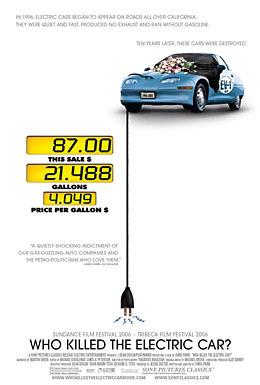 This is another decent documentary from 2006. Going into it, I was expecting a less publicized, but equally powerful Inconvenient Truth. With these expectations, I was disappointed, but I in the end, I feel that it held its own fairly well. Without trying to have political bias, I can imagine certain powers that prevented this movie from having a wider release. Despite the fact that some areas of the movie seemed a little glib and contrived, I still recommend it.
Who Killed the Electric Car? plays out almost like a crime scene investigation. It follows the rise, and eventual fall of the EV1- the first commercial electric car. Writer/Director Chris Paine investigates different suspects in the demise of the vehicle. General Motors (who manufactured it), consumers, the car itself, the California Air Resources Board, and others are all held up under the microscope. At the end, Paine actually points his finger at certain culprits placing responsibility on them, while exonerating others.
The movie is interesting, and has some very good points, but did not seem to be as powerful as I had expected. I was anticipating the same reaction as an Inconvenient Truth (After all, that was just a lecture- this was a full blown movie). Who Killed the Electric Car? just didn't hold as much weight to it. I can't exactly place my finger on why not. Martin Sheen provided a very good, yet sparse narration, owners and designers alike weighed in passionately, and it stressed the possibilities that could come with using electric cars. Perhaps it lost a little clout when it started relying on celebrity testimonies from Mel Gibson, Phyllis Diller, Tom Hanks, and others. I think their presence was there to show how difficult it had been to acquire these cars, and how high the demand really was- but they just don't seem to hold as powerful sway in a documentary setting.
The most passionate interviewee was Chelsea Sexton, the person in charge of marketing the EV1 in California. She had done everything in her power to create a demand (which there was), and convince GM of this demand (which they ignored). When GM decided to recall all the cars they had leased, she personally visited the owners. This led to the one genuinely powerful scene in the movie where several of the owners followed the cars to the junk yard, where they scrapped these perfectly good machines.
The movie featured a lengthy section on Hydrogen Power, citing it as a detriment to the electric car, and a detriment to the environment. Paine says that in theory, it's a good idea, but the electric powered cars are already viable, and will be much more effective, and much cheaper than hydrogen power. I found it interesting that he would tackle a competing environmental solution, which I liked. I thought it took some courage to attack a popular issue that may not sit well with the target audience. This truly is a documentary, and not just an opinion piece.
As is apparent with the title, the electric car lost. The movie ends on an optimistic note, however, with many of those interviewed talking about how excited they are about the future. The rise of the hybrids, and alternative bio-fuels have created a sense of hope among the environmentalists. The movie is largely depressing- highlighting the struggles of a vehicle and those who defended it, and how they were doomed from the beginning (The title alone tells you this much). It ends on an upswing, however, giving a hopeful, yet cautionary view of the future. The movie gets its point across very effectively, but relies a bit too much on celebrity testimony (and an absurd memorial service- don't ask). It's not the best documentary, but it does what a documentary should.
3.5/5
Monday, March 26, 2007
Zardoz
 You may wonder why I review some of the movies I do- and in complete honesty, I find myself wondering the same thing. For instance, why am I reviewing an obscure Sean Connery movie from 1974? The simple answer is that this movie is so deliciously bad that it warrants a review thirty years later. This movie was terrible, but I'm going to recommend it. It's sort of like Plan 9 From Outer Space. It's a horrendous classic everyone must see. But why should everyone see this movie? Three reasons. A genuinely interesting premise; a giant, flying, talking, stone head; and Sean Connery in a dress. Isn't that reason enough?
This movie was actually recommended to me by a teacher (as a great example of tepid film-making), and right there in class I jumped on Netflix and put it to the top of my queue. After watching the movie, I can say I was not disappointed. The idea of the movie I actually really like. It tells the story of a futuristic caste system where one group (Immortals) rules over another (Savages). The catch is that the Savages don't even know the mortals exist. They are trained to kill each other and farm, giving sacrifices to their god, Zardoz (the giant flying head). Sean Connery finds himself in the land of the Immortals, and they are immediately intrigued by him. The group is bored with their immortality, and find excitement in this change of pace. Eventually, however, Connery brings distrust and violence to the immortals.
On the surface this doesn't actually sound like that bad of a movie. Unfortunately the acting is horrendous. Sean Connery did this movie with an entire cast of unknowns, simply because he was fresh off of playing James Bond, and nobody would hire him for more serious roles. (If you've ever seen Finding Forrester, he's still struggling to find that role.) The acting almost works well together, though, because it's all so monotonous, but equally so.
Many parts of the movie are long and tedious, and others are long, tedious, and make no sense. I mean no sense whatsoever. It's hard for me to tell, but I'm pretty sure a lot of what happens contradicts other things. And at the end, the entire thing just falls apart. Honestly, it's almost as if writer/director John Boorman literally unraveled the script at the end, and threw together whatever randomness he could put down on film.
There are amusing moments with his interacting with many nude women, effeminate men, and various groups of immortals including the apathetic (pretty much anybody who watches the movie), and the renegades (crazy old immortals). They use him for tests, labor, and of course- sex. Connery takes all of this in stride, thinking that he is actually already dead.
This movie isn't a total loss, however. It has some social commentary to it- actually a lot of it. In fact, that's pretty much all it is. The entire movie revolves around a dominant class that keeps the other one subdued and enslaved. There's even sexism, and capital punishment sprinkled in there. Leave it to a cheesy 70's sci-fi flick to beat us over the head with lessons about discrimination. I do like the idea, I do like the message, and I do like...um...Sean Connery in a dress. I just wish the rest of the movie was on par with these three pluses. It's a shame that these messages would mean more coming from a better movie. Even though the movie is rather dreadful, I'm still going to encourage you to see it. It's still not as bad as some of the movies being made today (see my review of the Hitcher). Zardoz, despite all of its flaws may actually entertain you. Do I need to reiterate?- Sean Connery in a dress.
2/5
Subscribe to:
Posts (Atom)
