Monday, August 13, 2007

Rush Hour 3

Hahahahaha. Sorry, I was just thinking of the trailer for Superbad that preceded the movie. Unfortunately, that was the funniest part. Brett Ratner brings us the third installment of the Jackie Chan, Chris Tucker partnership. I honestly do not remember the premises of the first two movies. Something about Asian assassins I think? Maybe a crime syndicate or two? I dunno, I'm pretty sure that's what this is about anyway.

Of course Chan and Tucker reprise their perennial roles of detectives Lee and Carter to thwart yet another batch of crime lords- this time in Paris. This results in another rendition of the obligatory "Do you understand the words that are coming out of my mouth" line since they're dealing with a language neither of them know. This results in one of the few funny moments, when an elderly nun is interpreting insults between them and a suspect.

The other scene I actually enjoyed was an original car chase between a batch of motorcycles and a taxi. This was actually pretty exciting. The thrills and the humor take a break from the movie until the outtakes over the credits. The outtakes were actually pretty fun, since they show a lot of the stunts that go into the movie. As usual, Jackie Chan is very impressive, but it's still evident that he's getting older- he's in his 50's now. A lot of the stunts were green-screened in this movie. Oh well, even the best can't be jumping from building to building forever.

As for Chris Tucker, I'm pretty sure they could have taken footage of him from the first two, and simply edited it into this movie. I don't think there was a single original line of his in this outing. In fact, I'll bet he has enough canned phrases built up that he'll never actually have to work on another movie in his life. Must be nice to be that formulaic. In a completely odd twist, Roman Polanski had a supporting role in this. Roman Polanski?!

I'm prepared to put Ratner in the same league as Michael Bay now. Both of them make terrible, huge budget movies- though Bay still has the edge in the amount of money he can throw around. Almost everything each of these directors is gold at the box office, however. Rush Hour 3 is going to be no exception.

Watch the Trailer

1.5/5

Friday, August 10, 2007

Perfume: The Story of a Murderer

Tom Tykwer (Run Lola Run) directed this new German thriller. There are no jump out at you scares in this, just a long twisted plot, with the main character's actions difficult to fully wrap your mind around. It's interesting because much of the movie is utterly absurd, but in the context of the world that's created, not terribly out of place.

Perfume is split up into two acts, the first being the story of Jean-Baptiste Grenouille's (Ben Whishaw) childhood, and early working life. It's established that he has an uncanny sense of smell- perhaps the best in the world. After a series of grueling jobs, he finally becomes apprenticed by Giuseppe Baldini (Dustin Hoffman) a master perfumer. Grenouille helps Baldini recapture his glory by creating an endless stream of fantastic perfumes, and in return, Baldini helps in his ultimate quest- to preserve scent. Grenouille wants to capture the scents from everything- especially in what becomes the focus of the story; the scents of women.

In the second act, Grenouille has learned everything he can from Baldini, and sets off on his own to the perfume capital of the world- Grasse, in hopes of finally learning how to capture scent. Here is where the movie starts to take a dark turn, and Grenouille starts murdering women in his experiments to gather scent and create the perfect perfume. Alan Rickman joins the cast here as Richis, the father of Grenouille's ultimate goal, Laura (Rachel Hurd-Wood).

This is a thriller in that it's a story about murder. The audience is never in question as to who is doing it, however. The tension more lies in the question of whether Grenouille will finish his masterpiece before he is found out. Sometimes it's difficult to really care, however, because he is in general an unlikeable character. Grenouille is so driven by his obsession that it doesn't even seem to occur to him that he is killing people. A character like that- especially a main character, is very difficult to empathize with.

There are only occasional times in the movie where Grenouille really has any depth. There is a scene early on where he is in complete isolation, and realizes he has no scent of his own. This is where he starts to contemplate his own existence. Here there are feelings of isolation resulting from being a societal outcast. Unfortunately, after that scene this topic is not really touched on again. Ultimately, the movie ends with a rather unsettling, yet unsatisfying conclusion.

The scenes between Dustin Hoffman and Whinshaw are the best in the movie. The dynamic the two of them have- Hoffman being the stern master, and Whinshaw being the genius but ignorant student- are brilliant, and even more tense than the later parts of the movie. Unfortunately, this relationship is done before the movie is half over. I wish the second act could have been on par with these early scenes, but it just wasn't.

Watch the Trailer

3/5

Wednesday, August 8, 2007

New Academy Guidlines for Animation

There is a new rule being considered regarding the eligibility of movies for best animated feature for the Oscars. A new clause may be added saying that to be eligible a movie cannot start with live action, and simply use technology to augment that performance. Essentially this means that movies using motion capture techniques will not be considered animated movies. This would mean that both Monster House, and Happy Feet would have been ineligible to win last year. This has important implications this year as well, as the upcoming Beowulf movie is created entirely using motion capture.

What is the problem with Motion Capture? There are traditional concepts of animation that were developed in the earliest years of the genre. Some of these important techniques include squash and stretch (an objects ability to distort in an exaggerated manner), Anticipation (a character's behavior leading into an action), overlapping motion (different parts of an object moving differently), and many more. These concepts are all exaggerated, making realistic and entertaining motion. Motion Capture, on the other hand, simply takes data from an actor and transplants it onto a model. This results extremely subtle expressions and movements. Putting these movements on animated characters can have unpleasant results.

There was a theory devised in the 70's by Japanese robiticist Masahiro Mori called the Uncanny Valley. It was originally conceived pertaining to robotics, but applies perfectly to 3D animation as well. Essentially it tracks the relationship between realism and empathy. As a character's realism increases, a person's empathy towards that character also increases. This relationship only exists to a certain point. When a character is very nearly life-like, but not quite, the empathy level drops into a valley, before rising again at 100% realism. There are a number of reasons for this. When something is very nearly life-like, but not exactly, it becomes creepy. One common concept is to reference zombies. Reanimated corpses are humans, but they're not living. This concept played out in the Stepford Wives, where female robots were made to replace the women of the town. It's eerie because as life-like as they are, something was slightly off.

Regardless of the reason for this phenomenon, it can be seen in movies such as the Polar Express. The characters are incredibly life-like, but something is slightly off. The results are just creepy. Another example was last year's Monster House. The performances the actors give are so subtle that they just don't work on the animated characters. It's impossible to exactly match how a person would act, since we see other people every single day. This is what makes animators different from traditional actors. Screen actors can make a wonderful performance with the most subtle gestures and emotions. Animators, on the other hand, need to exaggerate everything. When you see an animator acting out a sequence to reference, the performance is beyond comically exaggerated. When you see the same actions on the final character, however, they fit. This is why animators really are actors for their characters.

There are certain negative implications with this new rule, however. Pixar has always been a firm opponent of motion capture, relying on straight animation for all of their movies. With their movie Cars losing last year to Happy Feet, they could not have been very happy. They may have been using some of their newfound clout stemming from their partnership with Disney to try to stack the category back in their favor. Even though I firmly feel that motion capture results in inferior animation, I sincerely hope that this is not the reason for this new rule.

Saturday, August 4, 2007

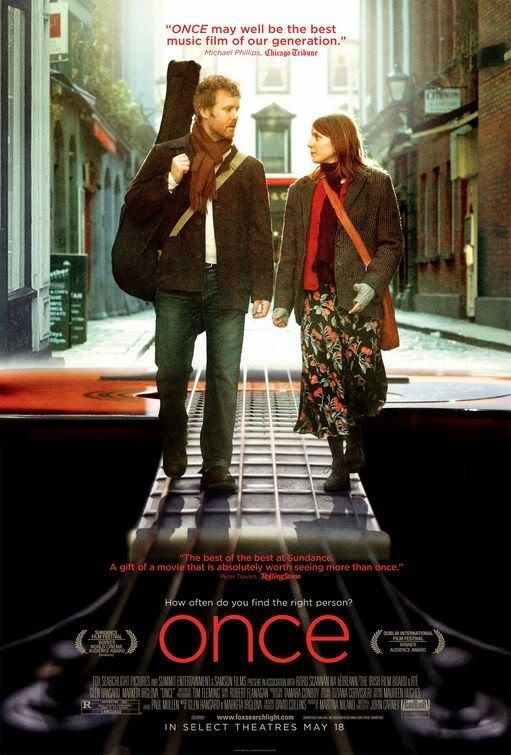
Once

Once is a musical; but don't worry, it's not Hairspray, and it's not Rent. Think more along the lines of Lost in Translation, except the lead characters sing. Once is a beautiful and heart-breaking story about a struggling musician, and a cleaning woman as their quests for themselves and for love bring their paths to cross. The music serves as a unifying theme between the characters- and no fears, there's no dance numbers.

Glen Hansard, lead singer for the Irish band The Frames, stars in the unnamed male role. He also wrote the music for the movie. He is a vacuum cleaner repairman by trade, but plays on street corners and records his own music at night. The fuel for his music?- a lost love of course. Markéta Irglová stars as the cleaning woman separated from her husband, and living with her mother and daughter. The two of them happen upon each other one day and follow a week-long relationship through music and self-discovery. Outside of a few glimmering and hopeful moments, they're relationship never becomes romantic.

Director, John Carney, used to be a member of The Frames, before he moved into film. Carney paints some amazing scenes in an almost documentary feel. The movie is shot completely with hand-held cameras (even tremendously complex crane shots were still hand-held). One amazing scene has Hansard and Irglová playing a song together in a music store. As the story progresses, and climaxes with the two of them recording an album with a band of street musicians, the soundtrack just gets better.

Like Lost in Translation, many complain that nothing happens in this movie- well, a little bit more happens in Once. This isn't important though. It's all about character development, which can sometimes be much more interesting than plot development. You really get the feeling of who these people are, and what they're feeling. In many heart-wrenching scenes, you genuinely feel like these characters are real. What does the title mean? It could be any number of possibilities. Is it one chance to reach your dreams? I'm more inclined to think that you're true love only comes once in a life-time. Who that is in the movie is up for even more debate.

This really is a wonderful movie. The characters are perfectly developed, and the soundtrack works so well it still brings tears to my eyes a week later listening to the CD. This is a fairly simple, low budget piece of cinema, but the characters and the music combine to create a near perfect bit of film-making.

Watch the Trailer

5/5

Copying Beethoven

This is another movie that had been playing at the Athens Film Festival this year, but unfortunately, I was not able to see it. Now that it is out on video I was finally able to see what I was missing. I must say, that it was worth the wait. Copying Beethoven is a fictionalized account of the great composer's last years. It opens four days before the premier of his 9th symphony as a new transcriptionist is hired to help him. The only catch is that it is a woman. The movie follows Beethoven's relationship with her, and others around him, all while struggling with his deafness and madness.

Ed Harris completely immerses himself in the role of Beethoven, like his turn as Jackson Pollock. I would not have known it was him until the credits. This movie just enhances Harris as being one of the greatest modern actors. Diane Kruger stars as Anna Holtz, the transcriptionist. She is a promising composition student, stuck in a field and an era where almost no women succeed. She sees helping "The Beast" Beethoven as a magnificent opportunity, but struggles to handle his violent mood swings.

Joe Anderson contributed his talents in the slightly tacked on role as Karl Van Beethoven, Ludwig's nephew. He provides a counterpoint to Harris, but doesn't do much further the plot. Matthew Goode plays Martin Bauher, engineer and Anna's love interest. He represents the conflict between the new developing world (Beethoven calls him an "Iron Man"), and Anna's desires for music. Again, he does not play an overly important role, just to enhance the conflict between Anna and Beethoven.

The story flows very uniquely in this movie. Essentially, the movie climaxes during the premier of the 9th symphony. Agniezka Holland directs this over ten minute scene more exciting than almost any action movie I have ever seen. Anna helps Beethoven conduct from behind the scenes, with different parts ranging from epic to sensual. This is the turning point for almost every character in the movie, and certainly the climax. The only catch is that there is still 45 more minutes. This is a perfect supplement to Beethoven's views on music, when he tells
Anna that she must stop thinking about beginnings and ends, and just let the music flow. Spending so much time on the falling action and resolution is like and extended, and very subdued coda. This has even sparked arguments that the movie is not about Beethoven or Anna, but simply about the music. Like Beethoven himself, the characters are just vessels for the music.

This movie is by no means another Amadeus (one of my favorite movies of all time). It certainly does hold its own merit, however. Harris captures this role with astounding power, and Kruger plays Anna as a fragile product of the era, with immense hidden strength. Besides, the soundtrack alone is enough to enjoy this movie.

Watch the Trailer

4/5

Friday, August 3, 2007

I Know Who Killed Me

I Know Who Killed Me almost had potential to be good. Almost. It started out being a psychological thriller in the same vein as Silence of The Lambs. It got confused, however, trying to shove too many incoherent ideas together into one movie, all while trying to please the crowd going to see this movie because of Lindsay Lohan. In the end, it just does not work.

First of all, I'll start off on something positive. Contrary to all of my expectations, Lohan did a fairly good job. She had a very difficult role playing the dual roles of Aubrey Fleming, and Dakota Moss. Yes she plays two characters again, but this is not the Parent Trap. One is the glowing child of a suburban family, and the other is child of a drug addict who strips for money. The catch- they're supposed to be the same person.

I'll try not to reveal anything that isn't shown in the trailers, so I'll briefly go over the plot. Aubrey Flemming is kidnapped. She appears several weeks later, but thinks her name is Dakota Moss. This is where the true mystery, and the potential of the movie comes into play. Are they really two different people? Does Aubrey have post traumatic stress? Is she caught in an alternate personality she created? Unfortunately, the answer to this question is not terribly important, and not all that interesting.

First of all, there are not one, but two or three full length scenes of Lohan dancing in an exotic club. Couple these with a sex scene between her and Brian Geraghtry and you know where priorities of the film-makers were. Not only that, the movie frequently descends into the torture/captivity genre with some very graphic scenes. This waisted time results in very little plot development until the last 20 minutes. The movie sets up an intriguing mystery, but does almost nothing with it until rapid fire revelations right at the end. Honestly, the movie is stuck in neutral for over half of its nearly two hour running time.

This movie just suffers from a lot of potential going nowhere. It mashes a series of fairly good ideas together, but never actually develops them into any sort of depth. If you like mysteries, and are willing to sit through an otherwise very mundane movie, you might like. It you like Lindsay Lohan, you will most certainly like this. If you prefer good films, stay clear of this one.

Watch the Trailer


2/5

The Simpsons Movie

I must admit that I was rather skeptical of this movie, especially after the disastrous Aqua Teens adaptation. The Simpsons Movie on the other hand, was extremely funny, and kept with the spirit of the show. I have been a fan of the show for as long as I have been watching TV, and the movie was the perfect step to the big screen. David Silverman, veteran Simpsons director (He was actually behind the pilot episode back in 1989), directed the movie exactly as it should have been done. It feels like an extended episode, but with much higher production values.

The story, which was written by a team comprised of all the legendary Simpsons collaborators (including Matt Groening himself, Mike Scully, and Ian Maxtone-Graham), does not have the disjointed feel that many screenplays written by a committee often posses. This could be a result of the over 150 drafts that the script went through. The premise deals with an overly polluted Springfield that gets sealed off from the rest of the country. Now the Simpson family must rescue their town. Yeah, kinda weak, but after 18 seasons, they've done everything. I think what makes this work is that it continues the underlying theme of the show, with this truly dysfunctional family barely holding together, and the continually strained marriage between Marge and Homer. Essentially the movie, and the show in general, are about Homer screwing up his family, and coming through in the end. They don't stray from this winning formula for the feature.

Of course all the core cast members (and even several that have since retired from the show) are back to lend their voices to the movie. It has the feeling that they were able to spend much more time recording the voices here than for the TV shows. The performances are polished, and spot on. The only thing more polished than the voice talents, is the directing. This is one of the aspects that I think made the movie so well. It's a lighthearted comedy, but the directing and cinematography are epic in scope. The seriousness in the look of the movie makes the characters and situations even that more absurd.

Of course it's not the greatest movie ever made. It's not much more than an extended episode of a long running TV show. Somehow, they still managed to make it fun, and at least moderately fresh. If you are a fan of the show, see it. You will not be disappointed. If you don't watch the show, you'll still probably enjoy it. I was only left with one question, how did it take them 18 seasons to make this movie?

Watch the Trailer

4/5